+86-531-88239557


Pulsed laser cleaning is a method of removing contaminants based on the delivery of laser radiation in short, high-power pulses rather than a continuous stream.
This approach differs fundamentally from the operation of continuous-wave lasers and opens up new possibilities for working with sensitive materials, where controlling thermal impact is critical.
The process by which a pulsed laser cleans a surface is called ablation. Ablation occurs when a high-peak-power beam is directed at a material. The material absorbs the energy, causing thermal expansion that generates shock waves on the surface. These waves begin to break down the material. Consequently, pulsed laser cleaning rapidly acts on the contaminant and removes it before the underlying base material has time to heat up. While there are several technologies for generating pulsed radiation, MOPA generation is the one most commonly used for cleaning.
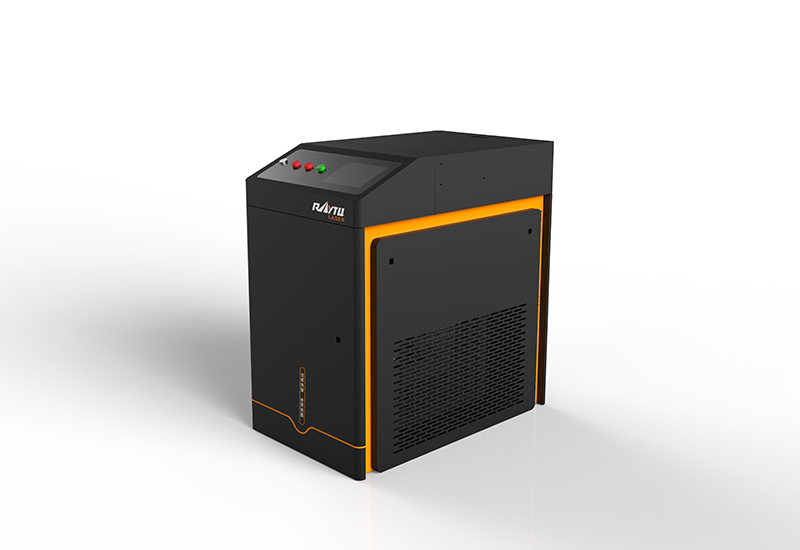
RAYTU Pulsed Laser Cleaning (100–1000 W) | ||
![]() | ![]() | ![]() |
| Mini-Cabinet Design – RAYTU LASER – Air-Cooled (100–300W) | ||
![]() | ![]() | ![]() |
| Suitcase-Style Design – RAYTU LASER – Air-Cooled (100–300W) | ||
![]() | ![]() | ![]() |
| Backpack-style Design – RAYTU LASER – Air-cooled (100–300W) | ||
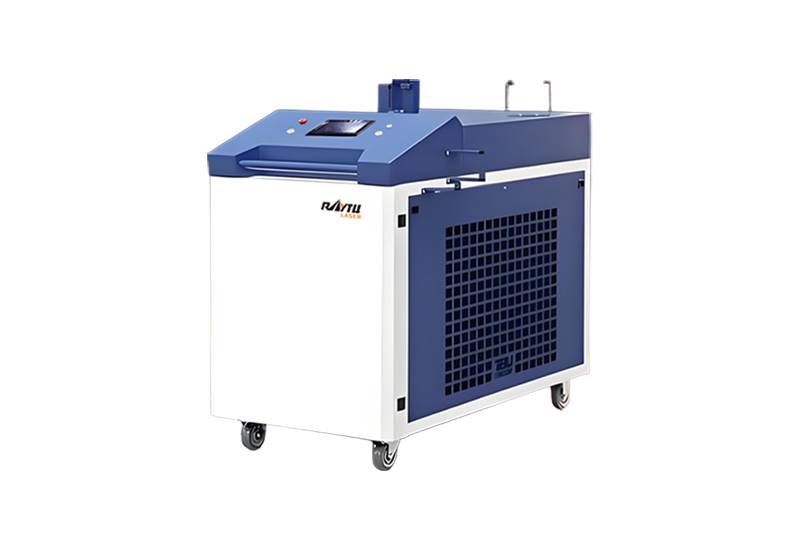
Mini Integrated Design – Water-Cooled/Air-Cooled (100–1000 W) | ||
Air-Cooled Pulsed Laser Cleaning Configuration JPT/JAX Pulsed Laser Source (1, 5, 15, or 50-module) with Air Cooling – Pulsed Laser Cleaning Gun + ZHIBO TECH/GUOYUAN Pulsed Laser Cleaning System – Touchscreen Water-Cooled Pulsed Laser Cleaning Configuration Pulsed laser source (single-module, 5-module, 15-module, 50-module) JPT/JAX – Pulsed laser cleaning gun + Pulsed laser cleaning system ZHIBO TECH/GUOYUAN (touchscreen) – Chiller for pulsed laser cleaning HANLI/S&A COOLING | ||
● Single-mode
Such a laser offers high beam quality, with an M² value close to 1. This means the laser produces a small spot that is nearly "ideal," allowing energy to be concentrated in a small area. However, the source itself delivers lower output power than a multimode laser.
A single-mode pulsed laser—also known as a Gaussian laser—is well-suited for removing rust and other contaminants that penetrate deep into the material.
● Multimode
Such a laser produces a larger spot, and the spot itself is non-Gaussian in shape. The energy is distributed evenly, resulting in a flat-profile beam. This type of beam acts more gently on the material, making it well-suited for removing thick layers of contamination or treating large surface areas.

● Minimal thermal impact. Pulsed laser delivery technology allows for the control of pulse duration and peak power. This gives the user precise control over the thermal impact exerted on the material.
● High precision. Thanks to a minimal heat-affected zone, rapid operation, and the precision of the laser beam, pulsed laser cleaning can remove even thin layers of contamination without damaging the base material. This is crucial when working with delicate surfaces such as wood.
● High cost. For now, pulsed sources are more expensive due to the Q-switch and MOPA technologies used to create them.
● Cleaning of automotive engines or electronics;
● Removing paint from the surface;
● Mold cleaning;
● Working with museum exhibits and outdoor monuments;
● Jewelry cleaning;
● Working with wood and other materials sensitive to thermal exposure.